XinChuang (Information Technology Application Innovation) aims for full autonomy and controllability over hardware and software. The essence of developing XinChuang is to address security concerns, and the operating system is one of the most critical foundational software layers.
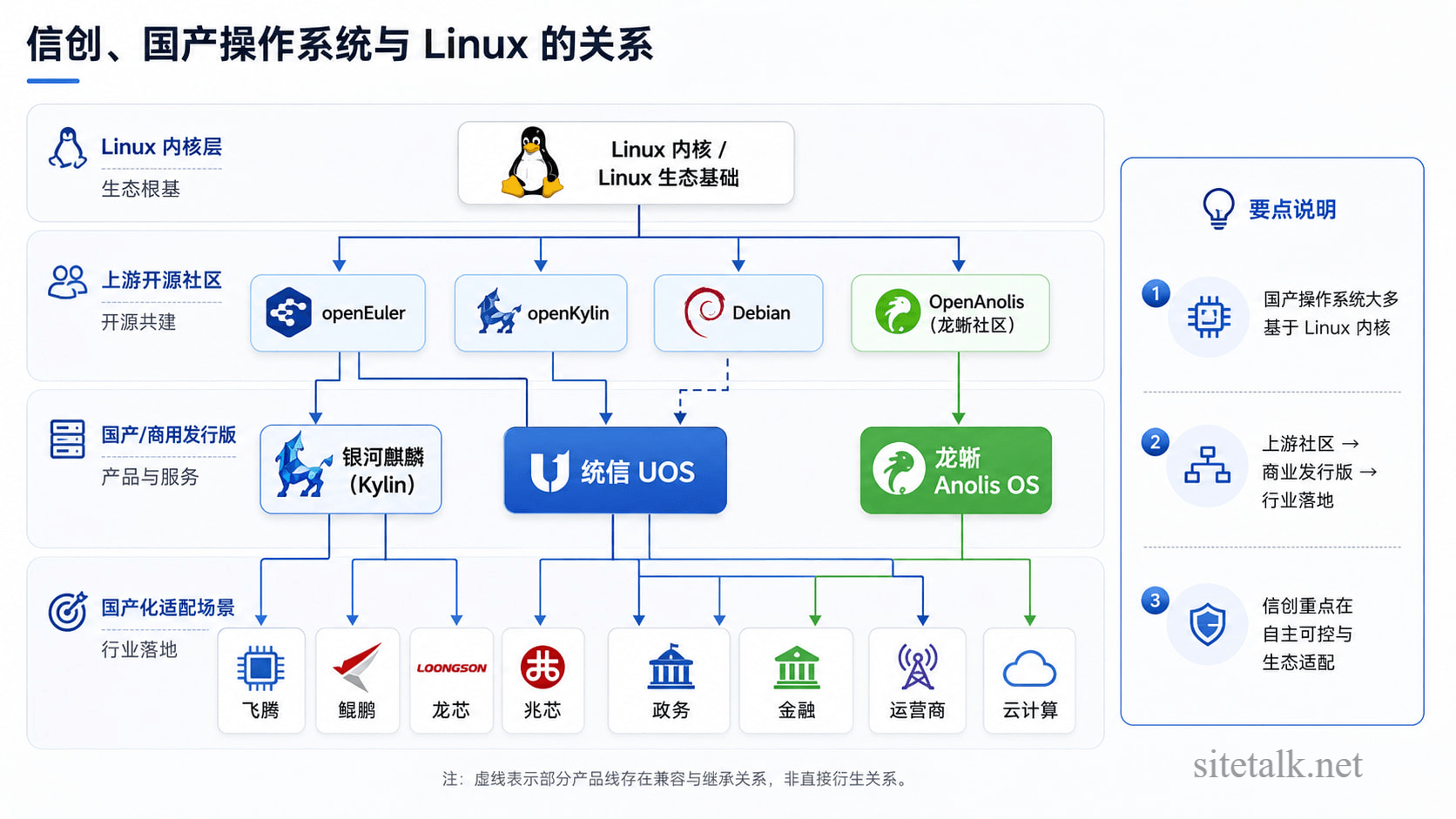
Core Relationship
Domestic Systems ≠ New Kernels, but Rather Chinese Distributions of Linux
Domestic mainstream XinChuang operating systems are not built from scratch with a new kernel, but are built on top of the Linux kernel, adding localization adaptations, security enhancements, support for domestic CPU architectures (Phytium, Kunpeng, Loongson, Zhongxin, etc.), and desktop/software ecosystem development, resulting in commercial distributions.
openEuler
openEuler is a Huawei-led, open-source community co-developed Linux operating system. The current version’s kernel is based on Linux Kernel 6.6, supporting mainstream architectures such as x86_64, ARM64, RISC-V, and LoongArch. It is an important upstream community in China’s server OS XinChuang ecosystem. Products like NeoKylin and UnityOS (UOS) Server participate in its community development and release commercial versions based on openEuler.
Features:
- Positioned for server, cloud, edge computing, AI, and embedded full-scenario use cases.
- Hosted by the OpenAtom Foundation, open-source and independently operated, not solely controlled by Huawei.
- LTS versions are released every 2 years, providing 4 years of community support; Innovation versions are released every 6 months, providing only 6 months of support, suitable for development environments that require the latest features.
- The current main and supported version is openEuler 24.03 LTS (released June 2024, based on Linux kernel 6.6), with a planned EOL of 2028; the latest SP3 was released in 2025.
- Recommended as the top choice for localization, serving as the upstream foundation for commercial distributions like NeoKylin and UnityOS (UOS) Server.
openEuler 24.03 LTS Series Support Periods
| Version | Release Date | Planned EOL |
|---|---|---|
| 24.03 LTS | 2024-05 | 2028-03 |
| 24.03 LTS SP1 | 2024-12 | 2026-12 |
| 24.03 LTS SP3 | 2025 | 2027-12 |
NeoKylin (Kylin)
NeoKylin is a domestic server operating system produced by KylinSoft. Versions V10 and later are built directly from the openEuler community, supporting domestic chip platforms such as Phytium, Kunpeng, and Loongson. The server OS V6 released in 2025 is based on openEuler 24.03, further enhancing domestic hardware compatibility and cloud-native capabilities.
- Positioned for key industries such as government, finance, and telecommunications, as well as general-purpose use cases. It is one of the domestic server operating systems with the highest market share in China.
- Supports x86_64, ARM64 (Kunpeng/Phytium), LoongArch, and other architectures, and provides an officially certified list of compatible domestic hardware.
- The desktop environment uses UKUI (self-developed), which is close to Windows user habits, reducing the migration threshold for government and enterprise users.
- Offered in two product lines: Desktop Edition (for end users) and Server Edition (for operations and cloud platforms), both providing long-term commercial support.
Support Period: NeoKylin Advanced Server OS adopts a “5 + 5 + 2 for a total of 12 years” support model.
- Standard support period: 5 years
- Provides feature updates, new hardware support, regular patches, and cumulative update versions.
- Extended support period: 5 years
- Primarily fixes security vulnerabilities and critical defects, guiding customers to gradually upgrade to newer versions.
- Extended support period (deprecation warning period): 2 years
- Fixes only a very limited number of critical security issues, while issuing deprecation warnings and strongly recommending migration to newer versions.
Summary: A single V10 major version can theoretically receive up to 12 years of lifecycle support from its release date, but the capabilities provided differ across each phase.
UnityOS (UOS)
UnityOS (UOS) is a domestic operating system launched by UnityOS Software, covering both desktop and server editions. The server version has deep cooperation with openEuler; UnityOS participated in the co-development of openEuler 24.03 LTS and released UOS Server Edition V25 on that basis. Notably, the underlying systems of different UnityOS product lines are not entirely the same — some versions are based on openEuler, others on Debian, and some on Anolis OS.
- The server edition provides 13 years of lifecycle maintenance, exceeding the 4–5 year level of international community versions, targeting long-term stability requirements.
- In terms of architecture support, it covers x86_64, ARM64 (Kunpeng/Phytium), Loongson, and other platforms, having passed multiple localization certifications.
Anolis OS
Anolis OS is an open-source operating system led by Alibaba, positioned as a CentOS-compatible alternative while also serving as a localization enabler in the XinChuang ecosystem. It provides two kernel branches: RHCK (compatible with CentOS/RHEL kernels) and ANCK (Alibaba Cloud enhanced kernel), offering more comprehensive support for domestic chips.
- Anolis OS 8 is the most widely used version for enterprise migration from CentOS, with high compatibility with CentOS 8 / RHEL 8, allowing direct reuse of existing RPM packages.
- It is also optimized for cloud-native scenarios, integrated with Alibaba Cloud infrastructure, making it suitable for in-depth learning of cloud-native technology stacks and domestic operating systems.
Support Period:[1]
| Version | Development Support | Maintenance Support | EOL |
|---|---|---|---|
| Anolis OS 7 | Ended | Expired | 2028-06-30 |
| Anolis OS 8 | 5 years | 10 years | 2031-03-31 |
| Anolis OS 23 | 4 years | 3 years | 2030-06-30 |
| Anolis OS 27 (not yet released) | 4 years | 3 years | 2034-06-30 |